




We have all been there. You watch a radiant player hold an angle, and their crosshair smoothly glides to the target for a clean, effortless one-tap. Then you look at your own gameplay, and it’s a frantic, jittery mess of missed flicks and panic sprays.
You are not alone. Achieving that precise, composed aiming style – often referred to as calm aim – is one of the most sought-after mechanical skills in the game. But calm aim is not just about how your screen looks; it is a byproduct of specific mechanics and physical tension management.
Whether you are bottoming out cloudy-sounding keycaps on a mechanical board or white-knuckling your mouse during a clutch, here is exactly how to develop a calm aim style you can replicate in your own ranked games.
What Actually is “Calm Aim”?
Most players fundamentally misunderstand what calm aim is. It is not just moving your mouse slowly. Calm aim is defined by smooth mouse movements that stop directly on the target.
It requires three core pillars:
- First-bullet accuracy
- Under-flicking (moving slightly short of the target rather than over-flicking)
- Patience with click timing
Rushing your shots and relying purely on twitch reactions creates chaotic, inconsistent gameplay. True composure in fights comes from mastering the physical and mental elements of your mechanics.
The Core Concept: Tension Management
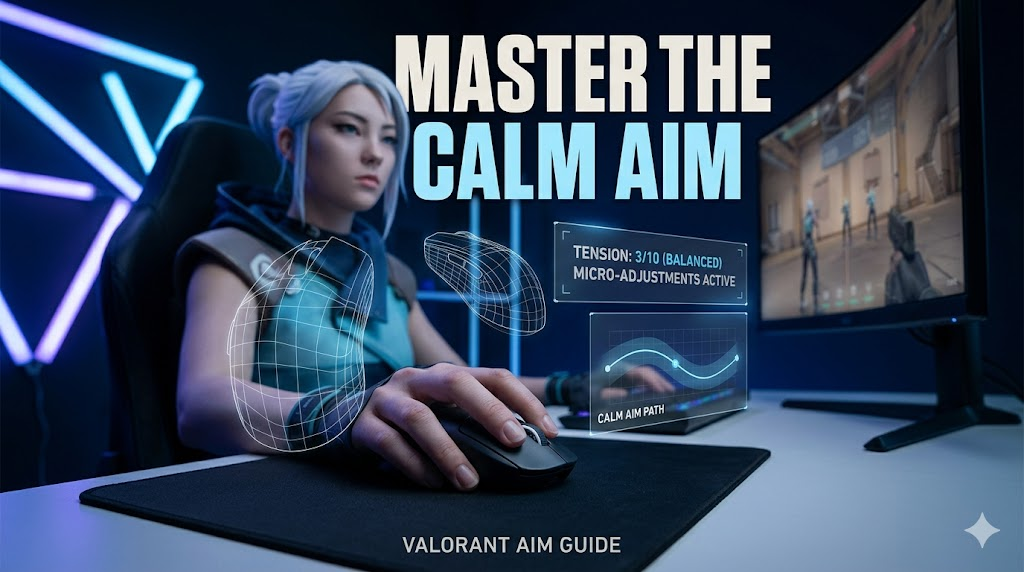
The most critical factor in achieving calm aim is tension management – essentially, how tightly you are gripping your mouse and flexing your arm.
The Grip Scale
Think of your grip as a sliding scale based on the intensity of the fight:
- Too Tight (The Death Grip): A tense arm and tight grip leave no room for the micro-adjustments required for pinpoint accuracy. It also causes severe arm fatigue.
- Too Loose (The Sloppy Grip): Holding the mouse too loosely results in a lack of control and slower reaction times because the mouse isn’t planted.
You must dynamically adjust your tension based on the situation. For example, if you are holding a long angle with a Vandal and need to track a tiny head, applying a bit more tension keeps your mouse planted, letting your fingers do the micro-adjusting. Conversely, if you are swinging Garage on Haven with an Operator, you want a looser grip to allow your wrist and arm the flexibility to hit massive left-or-right flicks.
The Mental Side of Tension
Physical tension is almost always a direct side effect of mental stress. We often unconsciously grip our mice harder in chaotic situations or when we know we have to hit a specific headshot to win a duel.
To combat this, try practicing mindfulness between rounds. Take deep breaths and physically sense your shoulders and hand. Letting go of the mental pressure at the root cause is the first step to relaxing your physical mechanics.

How to Train Calm Aim in the Practice Range
The practice range is the perfect controlled environment to normalize the stress of high-pressure gunfights.
Drill 1: The Hard Bot One-Tap
Set the bots to Medium or Hard and focus exclusively on hitting one-taps, returning your crosshair to the exact center of the screen after every single shot.
- Why it works: The speed of hard bots makes it impossible to spray (your recoil won’t reset in time). It forces you to prioritize speed and first-bullet accuracy under a strict time limit. Once you can comfortably hit one-taps under the pressure of the hard bot timer, the chaos of a real game feels significantly slower.
Drill 2: Movement Synchronization
Set the bots to Static Practice and begin standard A and D strafing. Your only goal is to fire your weapon on the exact frame the game allows you to be accurate.
- Why it works: Firing too early causes massive movement inaccuracy. Syncing your keyboard inputs perfectly with your mouse clicks builds the patience required to stop moving before you shoot.
Drill 3: Spray Control and Tracking
Poor spray control causes panic, which causes physical tension. Use moving targets or aim trainers to practice tracking an opponent while managing spray recoil. Tracking requires constant, fast changes in direction, which naturally tenses up your hand. Getting comfortable with spray transfers reduces the anxiety of missing your first shot, keeping you calmer overall.
Reinventing Your Deathmatch Habits
Deathmatch should not be a mindless space to just run around and frag. If you want to build calm aim, you need to use DM to practice specific goals.
- Buy Yourself Time: Get comfortable with how long it takes to actually adjust your crosshair, even if you die doing it. Use your movement to buy yourself extra fractions of a second to aim properly.
- Active Crosshair Resetting (Pre-Aim): Stop lazily tracking corners. Before you peek an angle, actively place your crosshair into the wall where you expect the enemy’s head to be, visualizing the left and right boundaries of the angle before you swing. Visualization has been proven to improve reaction times.
- Prioritize the First Bullet: Make your sole goal in a Deathmatch to only get kills with your first bullet. This heavily rewards patience and penalizes panic spraying.
Building the Habit
You have likely spent hundreds of hours building your current, frantic aiming habits. Breaking them will feel uncomfortable at first.
Do not constantly change your goals. If you want calmer aim, make it your primary focus for an entire week of ranked play – even if your performance dips in the short term. Put a sticky note on your monitor if you have to. By actively holding yourself accountable, you will eventually overwrite your panicked habits with cold, calculated precision.
