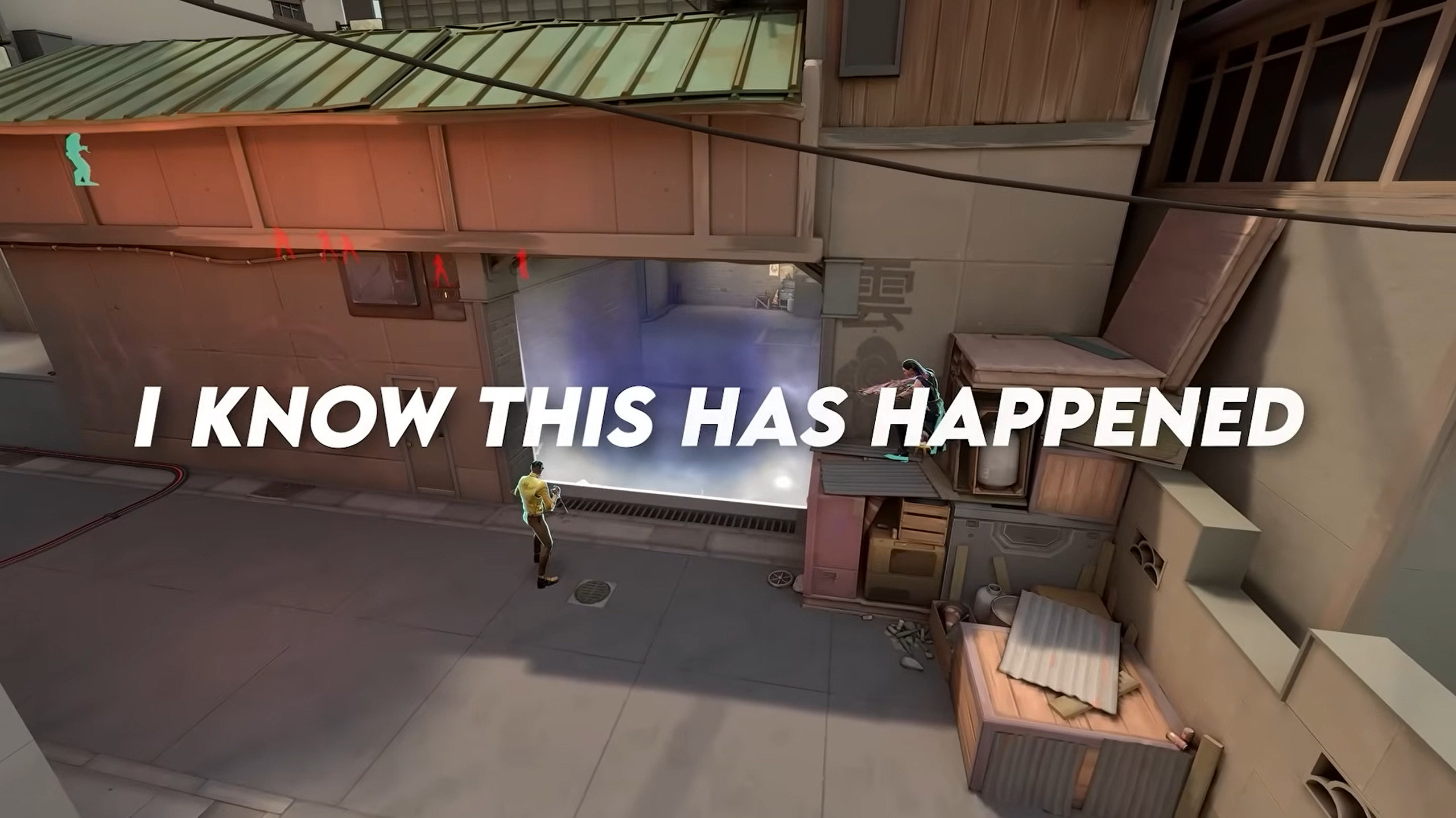





We have all been there. You know exactly where the enemy is holding. You confidently swing the corner, ready to click their head, and—bang. You are instantly one-tapped before your brain even registers the enemy model on your screen.
If this happens to you constantly, the harsh reality is that your peeking mechanics probably need a lot of work. But the good news? Executing a proper peek in VALORANT isn’t actually that mechanically difficult. The real ceiling that keeps players hardstuck is their micro-decision making and game sense.
Here is how the Radiant players and VCT pros make peeking look effortless, and how you can stop giving the enemy free kills.
1. The Geometry of Peeking: Distance and Weapons
The most fundamental rule of tactical shooters is angle advantage. The closer you are to a corner, the easier it is for an enemy further back to see your shoulder before you see them. But knowing when to break this rule is where game sense comes in.
- Long-Range Weapons (Rifles): You want to peek from as far back from the angle as possible. This allows you to “slice the pie,” isolating one enemy at a time while minimizing the amount of your character model exposed.
- Close-Range Weapons (Shotguns, SMGs): You actually want to peek closer to the angle. By swinging close with a Bucky or a Stinger, your movement appears incredibly fast on the enemy’s screen, completely throwing off their crosshair placement.
The best peek is always the one the enemy is least expecting. If you are in a 1v1, throwing in a jump-spot or a weird crouch-peek before swinging wide can buy you the precious milliseconds needed to win the duel.
2. The “T-Rule”: Stop Pressing the W Key
If your peeks feel sloppy or slow, you are likely holding diagonal movement keys. To fix this, you must adopt the T-Rule.
Imagine a straight line extending from the enemy’s eyes to the corner you are hiding behind. You need to peek perpendicularly to that line, forming a literal “T”.
- Only use the A and D keys. * Never use the W key when swinging.
Why? Diagonal movement appears significantly slower on the enemy’s monitor, making you an incredibly easy target. Furthermore, pressing multiple movement keys makes it much harder to stop your character on a dime. By strictly using A and D, you can deadzone and counter-strafe accurately, allowing you to shoot the exact moment you clear the wall.
3. Game Sense vs. Crosshair Placement
Having great crosshair placement is useless if you don’t have the game sense to know who you are fighting. Pre-aiming head height on a common angle is a fundamental skill, but high-level players use the context of the round to adjust.
For example, if you are clearing B Main on Fracture, your standard pre-aim might catch a typical Duelist. But if you are fighting a Chamber, you must expect him to hold a wide, aggressive off-angle because he has a teleport to bail him out. A perfect pre-aim peek should look like this: Place your crosshair into the wall where the enemy’s head will be -> take one or two lateral steps -> shoot. You should rarely need to make massive mouse adjustments if your game sense is correct.
4. The Sage Wall Drill
Want to practice your slicing and isolating without the pressure of a ranked match? Load into the Range, pick Sage, and place a wall directly in front of the practice bots.
Use the edges of the Sage wall to practice your lateral A/D peeking, exposing yourself to only one bot at a time. This perfectly simulates the spacing required to isolate angles in a real match, and allows you to practice stopping perfectly before you fire.
5. The Art of the Dry Swing
Dry swinging (peeking without using utility like flashes or recon darts) is incredibly risky, but it isn’t inherently bad. It is all about timing.
If your teammate is making massive amounts of noise or contact on the other side of the map, taking a confident dry swing while the enemy is looking at the minimap can secure a round-winning multi-kill. However, dry swinging into a heavily fortified angle just to try and force a trade with a weak weapon is a guaranteed trip to the spectator screen.
Ultimately, peaking is about confidence. The flashy pop-swings and jiggle-taps you see in VCT come from players who are confident in their reads. Learn the mechanics, stop holding the W key, and start taking your fights with intention.
FAQ: VALORANT Peeking Mechanics
Why do I get seen first when I peek? If you are hugging the wall too closely when you swing, “angle advantage” dictates that the enemy holding from further back will see your shoulder before your camera clears the wall. Always back up from the wall when peeking with a rifle.
What is slicing the pie? Slicing the pie is the technique of slowly stepping out to clear a wide area in small segments. It ensures you only expose yourself to one potential enemy angle at a time, rather than swinging wide into multiple crosshairs.
How do I counter-strafe in VALORANT? Unlike CS2, VALORANT characters stop moving very quickly when you simply let go of the movement key. However, tapping the opposite key (e.g., tapping ‘D’ while moving ‘A’) can help you completely halt your momentum to achieve perfect first-bullet accuracy faster.
