




Most players think they are losing their gunfights in VALORANT because of their raw aim. They spend countless hours in aim trainers trying to flick faster, spray better, and improve their raw mechanics. But the truth is, most gunfights in a tactical shooter are decided long before a single bullet is fired.
If you are consistently losing duels, it is usually because you are creating bad fights in the first place. Here is a complete breakdown of how gunfights actually work in VALORANT so you can stop relying purely on reaction time and start taking engagements that are already in your favor.
Understanding Aim: Passive vs. Active
To win more fights, you first need to understand the two different types of aiming in VALORANT: Passive aim and Active aim.
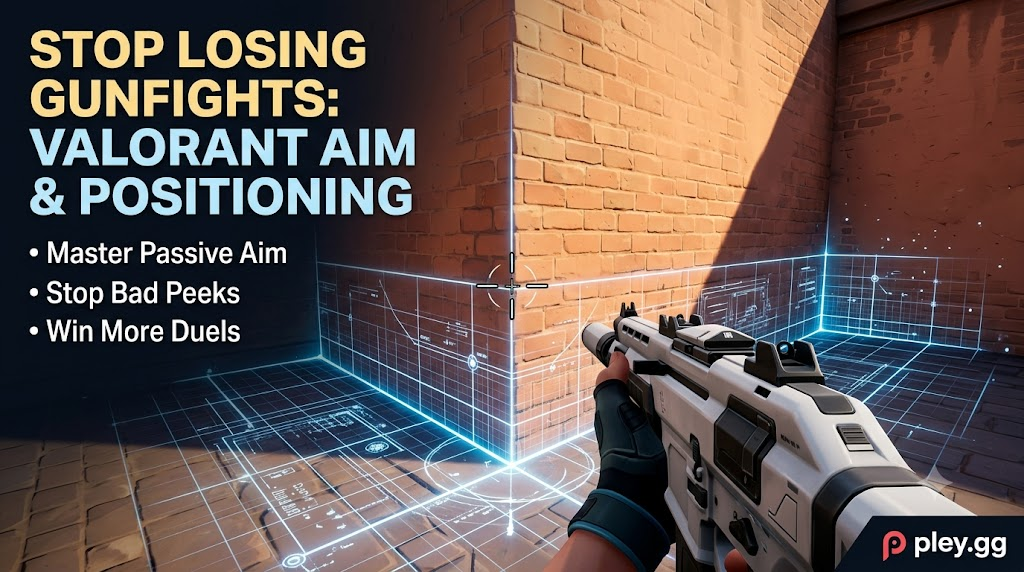
Passive Aim (The Goal) Passive aim is when your crosshair is already in the exact right place before the fight even begins. The goal is to reduce how much you need to physically react to an enemy appearing. This consists of:
- Pre-aiming: Placing your crosshair where an enemy is likely to appear through walls before you swing. However, only pre-aim when you have concrete information or are clearing a highly common angle. Do not lock your crosshair into a single spot if you are clearing multiple unknowns; keep your aim flexible.
- Crosshair Placement: This is where the vast majority of your kills should come from. The secret to high-level crosshair placement is adjusting it based on the enemy’s loadout. If the enemy is using a Spectre, expect a wide-swing and place your crosshair further out from the wall. If they have an Operator, expect a tight peek and hold your crosshair much closer to the angle.
Active Aim (The Fallback) Active aim is purely reactive. It is the raw mechanical flicking required when your crosshair is not already on the target. You are forced to use active aim when caught off guard, in a bad position, or when peeking without information. The goal of VALORANT is not to become the best active aimer in the world, but to set up your fights so you rarely ever have to use it.
Mastering Positioning
Positioning is what dictates whether you get an easy fight using passive aim or a difficult fight forcing active aim. Good positioning is not about hiding; it is about making the engagement inherently unfair for your opponent.
You want to force the enemy to flick onto you, rather than letting them pre-aim you. The most common positioning mistake is exposing yourself to multiple angles simultaneously. If two or more enemies can see you at once, you are forced to react to everything, plunging you into an active aiming disadvantage. Use map geometry, boxes, and tight peeks to block off secondary sightlines, turning one chaotic fight into isolated 1v1s.
Proper Movement and Peeking
Your movement in VALORANT exists to supplement your aim, not replace it. If an enemy appears and your crosshair is off-target, do not panic and force a sloppy shot. Instead, use your movement (strafing) to line up your crosshair while remaining a difficult target to hit, then stop and fire.
The 2-Bullet Rule: Never overcommit to a spray unless the enemy is heavily slowed or directly in your face. Make it a habit to fire only 2 to 3 bullets from a stationary position. If you miss, immediately move, reposition your crosshair, and fire again. Staying perfectly still while spraying makes you a completely stationary target for a return headshot.
How to Peek: When players complain about getting instantly one-tapped as soon as they peek, they usually blame the enemy’s aim. In reality, they are making predictable, uncontrolled, and wide swings directly into the enemy’s passive aim. Taking a shot, ducking behind cover, and re-peeking the exact same angle at the exact same speed is a guaranteed way to lose a duel. Move with purpose and constantly alter your peeking cadence.
Playing Off Information (The Minimap)
Even with perfect mechanics and positioning, information is the deciding factor in tactical shooters. Your minimap provides more vital data than your primary field of view ever will.
Low-level players only react to what appears on their screen. High-level players react to what is happening everywhere else. The minimap constantly reveals enemy locations, teammate sightlines, and crucial gaps in map control. If your teammates have completely cleared A-site and mid, and your screen is empty on B-site, the minimap is telling you that a late flank or heavy rotation is imminent. Get into the habit of glancing at your minimap when you are safe behind cover, holding a quiet site, or sitting inside a smoke.
Bonus Habits to Win More Fights
- Always Reposition After Contact: Never stay in the exact same spot after firing your weapon or getting spotted. Once the enemy knows where you are, you are being pre-aimed. Even taking two steps to the left breaks their crosshair placement and resets the fight in your favor.
- Jiggle Peek for Information: Never fully swing a corner if the enemy could be holding you from multiple different elevations or angles. Use a tight jiggle-peek to bait out a shot or gather visual information first. If they reveal their position and hold the angle, you can now safely pre-aim them or fall back to find a better fight.
