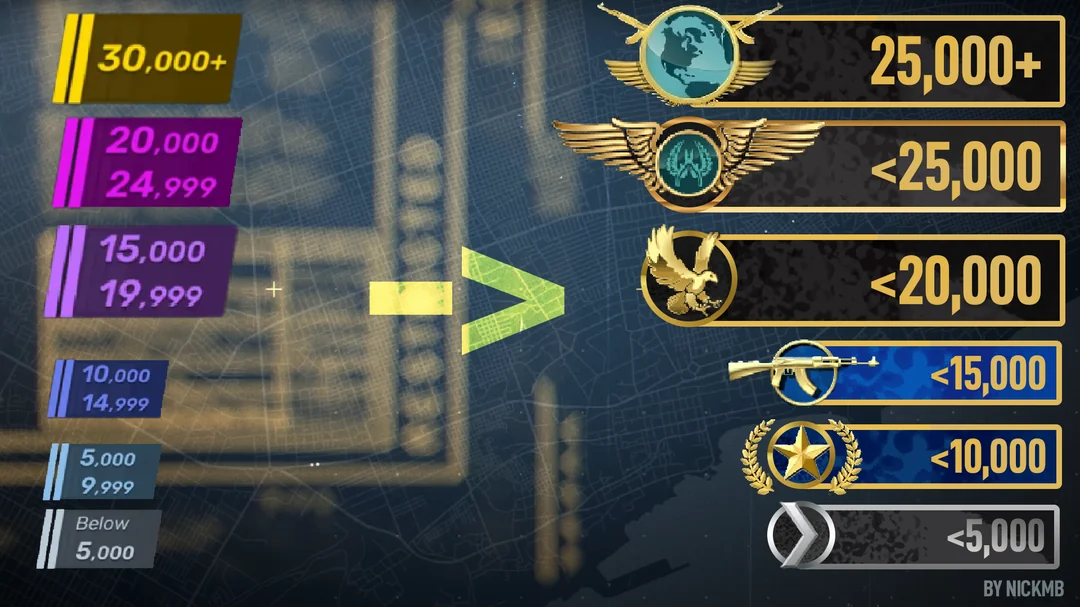







Are you an average CS2 player, or have you broken away from the pack? The CS2 rank distribution data separates community feeling from hard facts. If you’re trying to figure out if your rating places you with the majority of the player base or in the top tiers, you have to look at the numbers.
At Pley.gg, the broader ranks guide already explains how Premier works, especially for Season 4 Premier changes. This article answers the follow-up question most players care about once they have a rating: where does that number place you relative to everyone else?
The strongest public snapshot available for that is Esports Tales’ January 2026 distribution table, which is built from Leetify data. Leetify’s public data library also lists a February 2026 sample of 2,799,960 ranked players, which makes it possible to estimate how many tracked accounts sit inside each rating band.
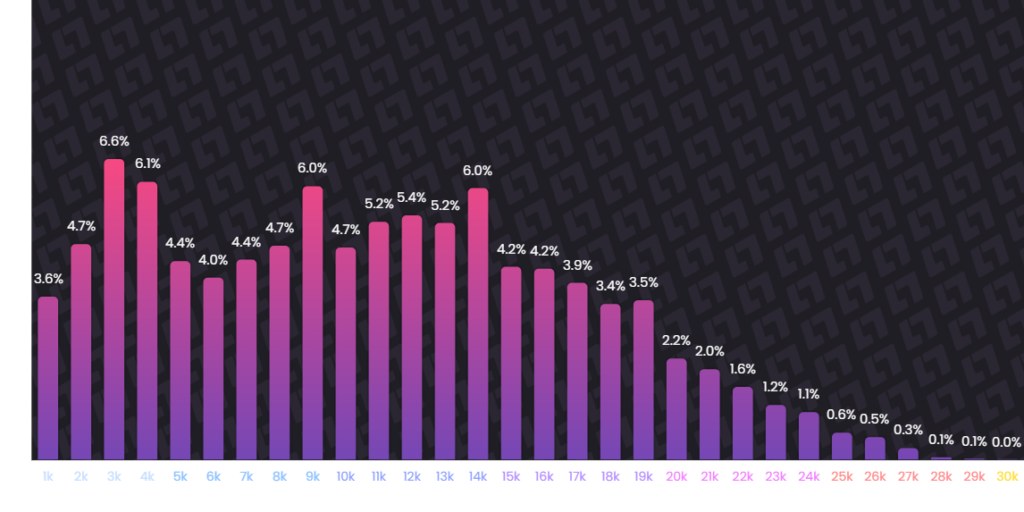
That methodology matters. Valve does not publish a full official public rank census for every Premier bracket, so the percentages below are best treated as a reliable third-party snapshot rather than a complete official player count. In other words, the percentages are the main story, while the “number of players” column is there to give scale.
CS2 rank distribution table: Where most Premier players actually sit
The easiest way to read the ladder is by band, not by single 1k buckets. That makes it much clearer where the center is, where the upper tier begins, and where the player pool starts to collapse.
| Premier rating band | Share of players | Approx. tracked players* |
|---|---|---|
| 1k to 4k | 19.0% | ~532,000 |
| 5k to 9k | 22.2% | ~621,600 |
| 10k to 14k | 27.0% | ~756,000 |
| 15k to 19k | 20.6% | ~576,800 |
| 20k to 24k | 9.4% | ~263,200 |
| 25k to 29k | 1.83% | ~51,200 |
| 30k | 0.01% | ~280 |
*Grouped from the published January 2026 Premier percentages and scaled against Leetify’s February 2026 public sample of 2,799,960 ranked players. Because the source percentages are rounded, totals land slightly above 100%.
CS2 rank distribution from 1k to 4,999
The first thing this band does is correct an old assumption. Early in CS2, a lot of players treated the gray ratings as the natural home of the player base. The January 2026 distribution does not show that. The entire 1k to 4k range combines for 19.0%, which means the whole lower opening tier is smaller than the 10k to 14k band by itself. That is a strong sign that the ladder has moved upward and stabilized compared with the launch period.
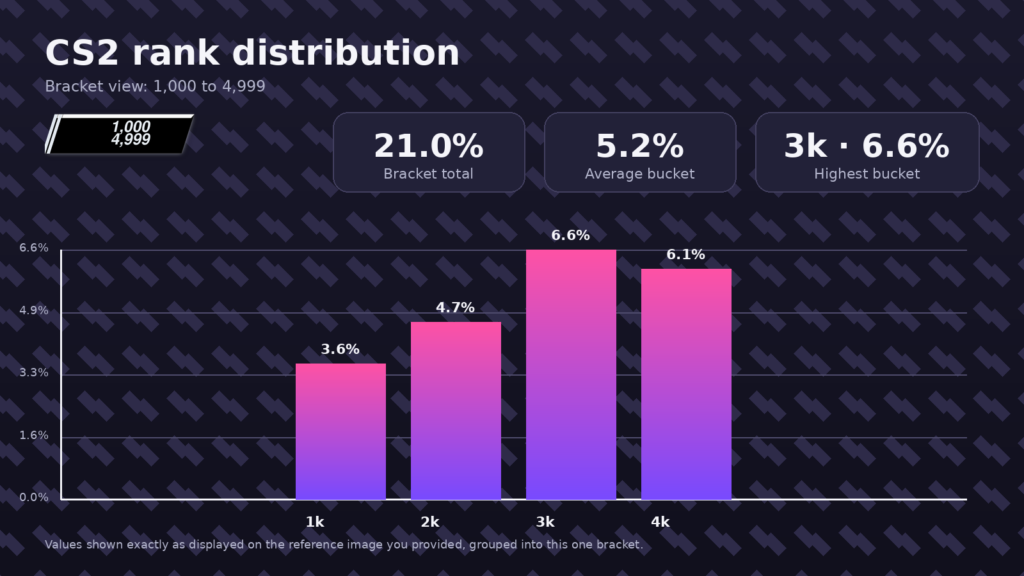
That does not make this bracket insignificant. It still represents roughly one in five tracked players, which is a large population in absolute terms. But in ranking terms, it now sits clearly below the middle of the game. If someone asks whether 3k or 4k is “normal,” the better answer in 2026 is that it is common, but no longer close to average. The average published Premier rating is 11k.

CS2 rank distribution from 5,000 to 9,999
This band is important because it explains why 10k still feels like a real milestone. The 5k to 9k range accounts for 22.2% of the ladder, and when you combine it with the 1k to 4k band, you get 41.2% of players under 10k. So crossing 10k means moving ahead of roughly two-fifths of the tracked player base, not just collecting a nicer color.
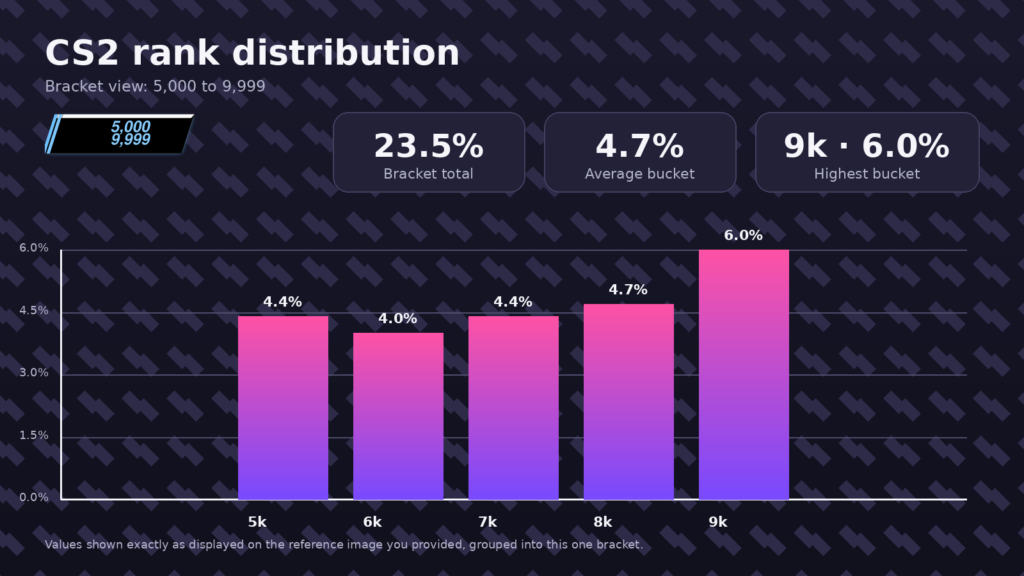
It is also where the lower half of the ladder becomes most concentrated. The largest single bucket below 10k is 9k at 6.1%, which suggests the climb tends to bottleneck just before the true middle of the distribution. That makes this section of the player ranking ladder feel more important than it first looks. It is not elite territory, but it is the last major staging area before the population shifts into the blue middle.
CS2 rank distribution from 10,000 to 14,999
This is the center of modern Premier. The 10k to 14k band holds 27.0% of players, more than any other grouped range in the table, and the most common single bucket is 14k at 6.5%. The source also places the average rank at 11k, which means this section is not just busy, it is the part of the ladder closest to the actual midpoint of the active ranked population.

That context matters because this bracket is easy to misread. In older discussions, 12k or 14k could sound borderline elite simply because early CS2 distributions were compressed. Pley.gg’s current ranks guide makes the opposite point: by 2026 the ladder has largely normalized, even if 10k to 15k remains a volatile trench with a wide spread of actual skill. That is exactly why this band deserves its own explanation. It is where “average,” “decent,” and “good” start bleeding into each other.
CS2 rank distribution from 15,000 to 19,999
This band is where above-average starts to become a more defensible label. The 15k to 19k range contains 20.6% of players, which is still a large section of the ladder, but clearly smaller than the central 10k to 14k block. That distinction matters because 15k is often described too dramatically, either as “nothing special” by high-level players or as “insanely high” by everyone else. Still, this ranking, although high is still lower than some of the best CS2 players out there.
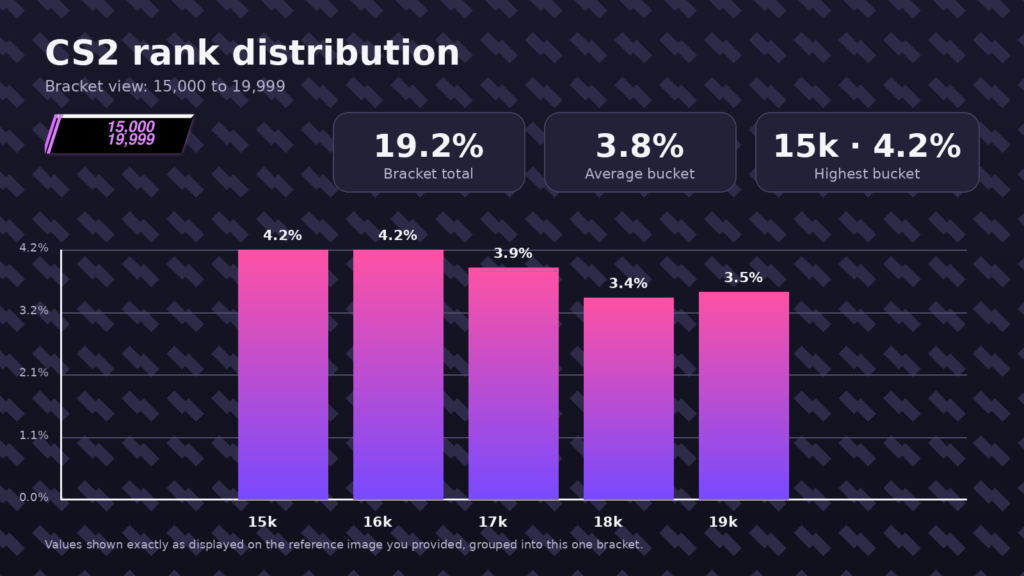
A player ranking in this band sits comfortably above the published 11k average, but it is not yet rare in the statistical sense. There are still hundreds of thousands of tracked accounts here in a 2.8 million-player sample. So the right framing is not “elite,” it is “clear upper tier of the general player base.” That is a stronger and more useful description for readers than simply saying 15k is good.
CS2 rank distribution from 20,000 to 24,999
This is the first CS2 rank distribution band where the numbers start sounding exclusive on paper. The 20k to 24k range accounts for 9.4% of players, and when you include every bracket above it, 20k and up totals about 11.24% of the tracked population. That means reaching 20k places a player somewhere around the top 11% of the public sample, which is probably the cleanest single “how good is this?” answer in the entire article. This rank is where CS2 callouts are more like a regular conversation, and are often drowned with callouts from other teammates with no confusion between players.
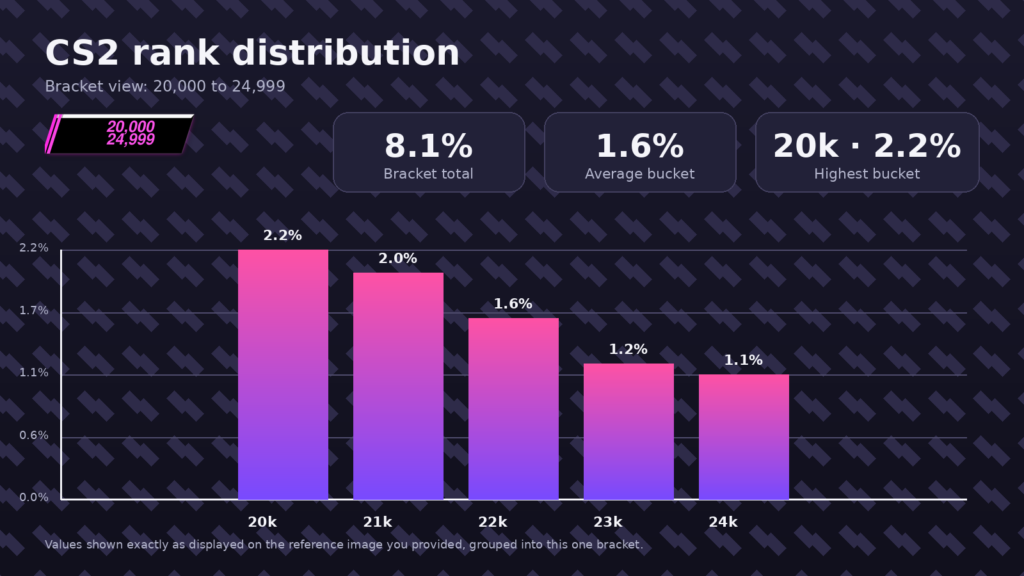
That also helps separate “strong” from “rare.” A 20k rating is clearly strong. It is not a launch-era unicorn anymore, but it is still well outside the crowded middle of the ladder. Readers looking for a practical interpretation can think of it this way: the distribution no longer treats 20k as impossible, but it still treats it as selective.
CS2 rank distribution from 25,000 to 29,999
The jump from 20k to 25k is where rarity begins to accelerate. The combined 25k to 29k band holds just 1.83% of players. That is a dramatic drop from the 9.4% sitting one tier below, and it shows how quickly the upper tail of Premier narrows once you move past the low 20s.

This is why the high-end ladder feels different from the rest of the article. At 15k or even 20k, you are still discussing large chunks of the player base. At 25k and above, every extra 1k starts removing a meaningful portion of the pool. In the scaled sample, the whole 25k to 29k range works out to roughly 51,200 tracked accounts, which is tiny compared with the bands below it.
This is the part of the CS2 rank distribution where “high rating” turns into “rare rating.”
CS2 rank distribution at 30k
The published January 2026 CS2 rank distribution table tops out at a 30k bucket, and that bucket is just 0.01% of players. Scaled against Leetify’s 2,799,960-player sample, that comes out to roughly 280 tracked players. Even with all the caution that should come with third-party sampling, the conclusion here is straightforward: this is the visible tip of the ladder.
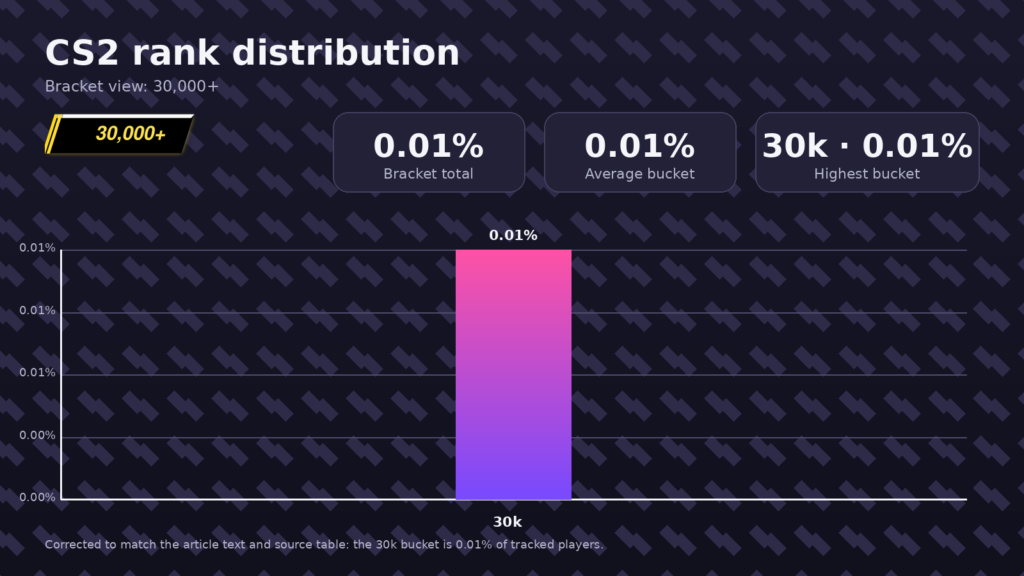
It is worth being precise with the wording. This article is not saying that only 280 people in the world are above 30k. It is saying that in the public tracked sample used here, the 30k bucket is so small that it rounds down to a statistical edge case. That is a much more useful way to explain the top end than simply calling it “very rare.”
What the CS2 rank distribution actually tells us
The broad shape of the ladder is now easy to describe. The lower half is still substantial, with 41.2% of players under 10k. But the real center of Premier sits higher, because 10k to 19k contains 47.6% of the distribution and the published average is 11k. So the modern player ranking curve is not bottom-heavy. It has a broad middle and then a sharp drop once you move into the high 20s. With the changes CS2 is going through, these might change from season to season.
That is the main reason this topic matters. A rank only becomes meaningful once you place it inside the full ladder. In 2026, under 10k is common, 10k to 14k is the true center, 15k to 19k is clearly above average, 20k and above is strong, 25k and above is rare, and 30k sits on the edge of the public distribution itself. That is a much more useful answer than simply telling readers what color their rating is.
