



The CS2 player count stands as the definitive industry benchmark because it relies on a decades-old mechanical foundation rather than seasonal content drops. While competing titles rely on battle passes to retain audiences, Valve maintains a baseline of over 1.05 million average concurrent users purely through the core tactical loop. This stability provides developers worldwide with a realistic, mathematically proven ceiling for multiplayer shooter longevity.
The hard data behind the CS2 player count
Tracking platforms like SteamDB and Steamcharts highlight a massive difference between Valve‘s flagship title and the rest of the market. The exact metrics reveal a self-sustaining ecosystem that does not rely on seasonal content drops.
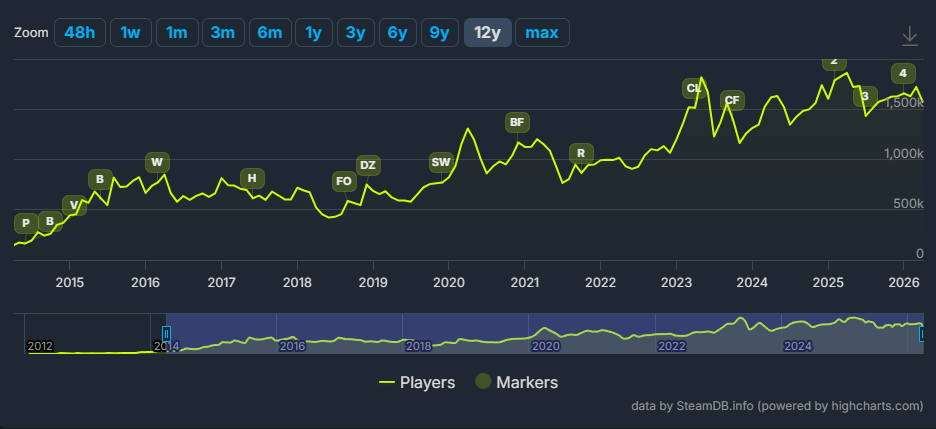
Most competitive shooters experience a heavy drop in engagement just months after launch. Competing titles lean entirely on aggressive marketing and battle passes just to maintain a fraction of their daily users.
The CS2 player count tells a completely different story. The baseline average sits at roughly 1.05 million concurrent users logged in at any given second throughout a standard 30-day period. When looking at the daily peak, that number frequently surges past 1.4 million simultaneous users during peak global hours.
A self-sustaining tactical loop
Gamers log in to interact with the Steam Community Market or grind their rating on the Premier leaderboards. They also spend hours running private servers to practice utility lineups on legacy maps like Inferno and Nuke.
This persistent daily routine artificially inflates retention rates organically. It completely removes the need for constant developer intervention just to keep the servers populated.
Core mechanics driving the CS2 player count
Other developers actively monitor the active Valve user base to measure market saturation and timing for their own releases. The consistency of this population offers a reliable measuring stick for the tactical shooter genre.

Several highly specific factors contribute to this sustained engagement:
- Esports integration: Viewership from major live events like IEM Katowice translates directly into immediate in-game population spikes as spectators transition back to playing.
- Economy mechanics: Virtual item trading gives digital assets real-world financial value, creating a permanent economic incentive for users to remain active within the client.
- Hardware accessibility: Engine optimization allows gamers with mid-range setups to compete globally, securing a massive audience extending heavily into South America and the CIS region.
- Mechanical purity: Relying on raw aim and utility usage over rigid character classes ensures the gameplay meta never alienates returning veteran players.
Analyzing ongoing player base trends
Comparing these specific statistics against the broader market highlights exactly why the CS2 player count remains the gold standard for success. Trends show that even during periods without major content operations, the baseline engagement rarely falters.
| Metric Evaluated | CS2 Performance Standard | Standard Shooter Lifecycle |
| Daily Peak Concurrency | 1.4M to 1.7M users | Peaks at launch, drops heavily |
| Global Audience Distribution | Massive in Europe, CIS, and Brazil | Often strictly regionalized |
| Core Retention Driver | Competitive ranks and item economy | Seasonal battle passes |
| Event-Driven Surges | High conversion from Major tournaments | Minimal impact from esports |
The numbers extracted from Steam APIs confirm that tactical depth generates permanent retention. As long as the core gunplay and economy remain intact, the CS2 player count will continue to serve as the absolute blueprint for multiplayer success.
The long-term impact on the competitive market
Looking ahead, the influence of Valve‘s tactical shooter extends far beyond its own community. When new multiplayer games enter development, their success metrics are instantly compared against the CS2 player count.
Gamers are becoming incredibly selective with their time, making high retention rates much harder to achieve across the board. Yet, the Counter-Strike formula proves that respecting the skill ceiling of the community pays off immensely. It forces competing studios to prioritize refined gameplay over aggressive monetization.
Ultimately, this is exactly why the title acts as the ultimate industry benchmark. It strips away the unnecessary elements of modern gaming. As long as the servers stay online and the community market thrives, the CS2 player count will continually dictate what true esports success looks like.
