



Less than a few months after enduring one of the most volatile periods in its history, the multi-billion-dollar Counter-Strike 2 (CS2) skins economy is on the verge of a complete recovery.
Recent market data from Pricempire reveals a dramatic V-shaped rebound. At the height of the panic late last year, the total market capitalization of CS2 skins plummeted to a low of $3,513,433,573.68. Today, according to Pricempire, it has climbed steadily back up to an impressive $5,698,637,274.69. For financial onlookers and community traders alike, this nearly $2.2 billion bounce-back is a startling display of resilience for an unregulated digital market that seemingly faces constant existential threats.
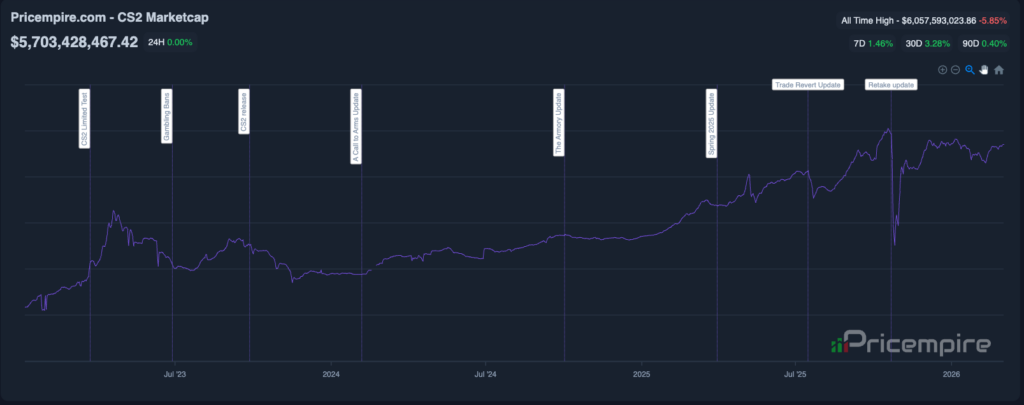
The current upward trajectory paints a picture of a market moving on as if the recent chaos never happened.
The Trade-Up Crash and Continuous Difficulties
To appreciate the scale of this recovery, one must look at the immense pressure the skins economy has faced. The massive dip shown in recent charts was initially triggered by Valve’s unprecedented decision to introduce “knife trade-ups.” By allowing players to exchange five Covert skins for a guaranteed rare special item, Valve flooded the market with high-tier knives and gloves. Virtual wealth evaporated overnight, dragging the market cap down to its $3.5 billion trough.
But self-inflicted market crashes are only part of the story. The CS2 economy operates under a continuous cloud of legal scrutiny, which peaked once again just last week.
New York Attorney General Letitia James filed a high-profile lawsuit against Valve, targeting the game’s core loot box mechanics. James alleges in the lawsuit that “Valve has made billions of dollars luring its users, many of whom are teenagers or younger, to engage in gambling in the hopes of winning expensive virtual items that they can cash in on.”
Crucially, the investigation also takes aim at the broader skins ecosystem. A press release from the Attorney General’s office states that the investigation found Valve “facilitates and even assists” third-party marketplaces where virtual items can be sold directly for cash.
A History of Regulatory Scrutiny
The New York case is merely the latest in a growing number of regulatory challenges Valve has encountered worldwide. In 2018, opening cases was restricted in the Netherlands after the Dutch Gaming Authority classified paid loot boxes as gambling. While that specific ruling was overturned in 2022, case openings remain restricted in the country today.
The pressure is also mounting across the rest of Europe. In October 2025, the Internal Market and Consumer Protection Committee adopted a report recommending the European Commission ban loot boxes for minors under the age of 16.
Valve has shown signs of adapting to these continuous difficulties. In September 2025, the developer released the “Genesis Uplink Terminal” in Counter-Strike 2. This feature allows users to directly purchase a skin offered by an in-game “arms dealer,” marking a significant, albeit partial, pivot away from the traditional randomized loot box method.
An Unfazed Community
Historically, regulatory threats of this magnitude coupled with massive supply shocks would be enough to permanently freeze speculative markets. Yet, the CS2 skins market has effectively shrugged off both the developer-induced crash and the ongoing legal battles.
Instead of a sustained sell-off following the New York lawsuit last week, investors and players continued to buy the dip. The high volume of trade-ups stimulated transaction movement, and traders seem to have fully priced in the constant threat of government regulation.
Today, sitting at nearly $5.7 billion, the total market cap is within striking distance of its pre-crash peak. Whether driven by genuine passion for the game’s cosmetic status symbols or sheer speculative momentum, the market has absorbed the blows and kept climbing.
While lawmakers continue to cast a long shadow over the future of virtual items, the immediate verdict from the community is clear: the CS2 skins economy is back in business.
