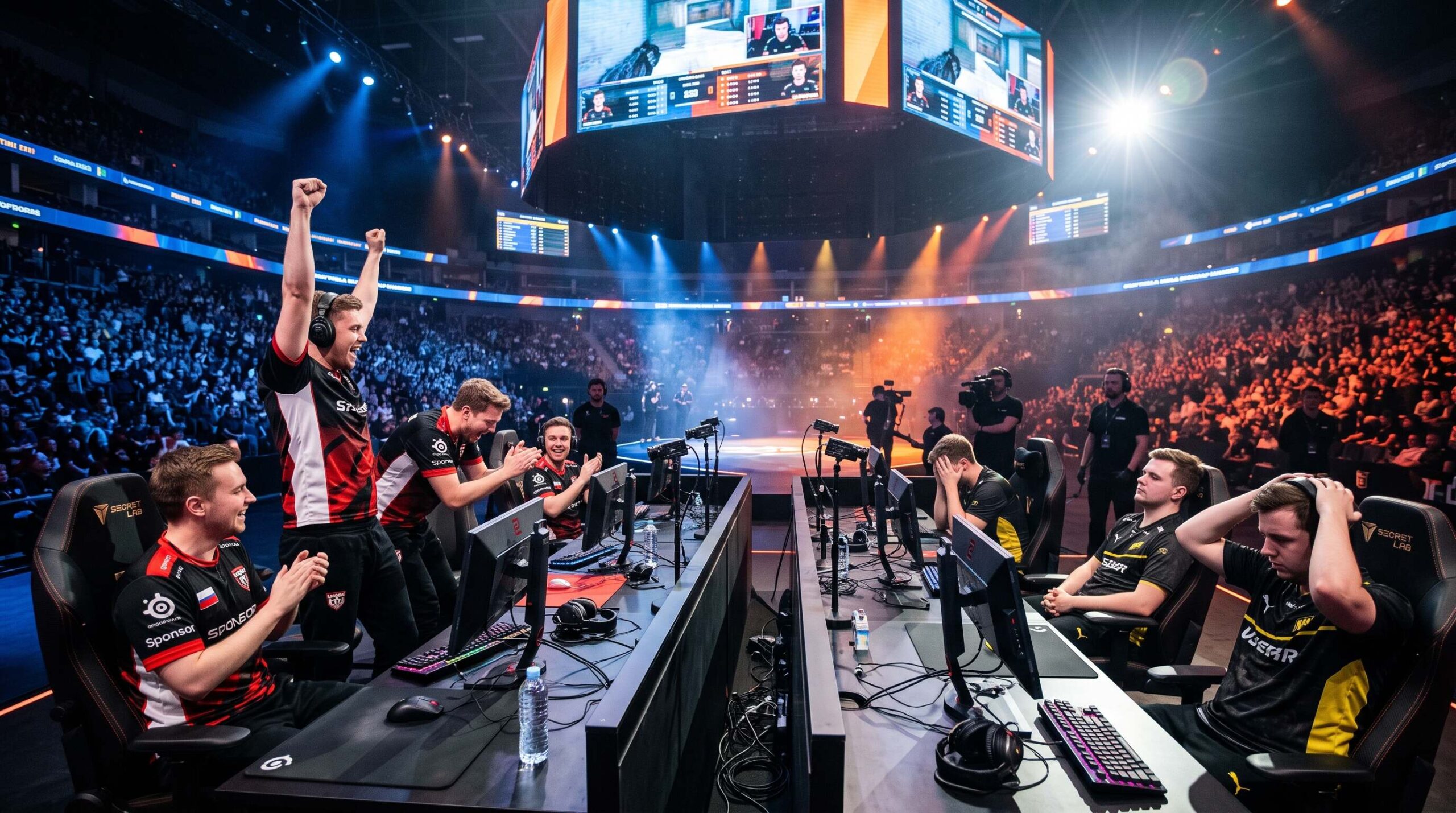




The 2026 CS2 season demonstrates how rapidly the balance of power shifts in Counter-Strike. A successful transfer can elevate an underdog to a top 10 position within months, while established organizations face immediate difficulties following minor role adjustments. This becomes clear when comparing recent tournament results, map pools, individual ratings, and the current HLTV world rankings.
Names and market value alone do not guarantee success. As with any highly competitive environment, the combination of a functioning system, calculated risk, and actual server performance dictates the final outcome. As of October 5, Spirit leads the HLTV world rankings, followed by Vitality and MOUZ. Legacy sits at number 6 and FUT at number 8, representing two rosters few expected to see in the top 10 prior to the season. NAVI trails at number 10, while BIG remains stuck outside the immediate world elite.
Those who follow esports recognize an established principle visible across multiple gaming sectors: individual names and high market value alone do not generate success. Similar to other digital entertainment formats, ranging from highly competitive titles to the online casino, the final outcome depends entirely on the exact synthesis between a functioning system, calculated risk, and concrete performance.
FUT completes the jump from academy project to tier 1 contender
FUT represents one of the most remarkable stories of the current season. The core of the roster originated from players with an academy background. Dmytro “dem0n” Myroshnychenko, Aulon “Krabeni” Fazlija, and Džiugas “dziugss” Steponavičius developed from interesting talents into players capable of competing against established tier 1 opponents in a short timeframe.
The definitive breakthrough occurred in 2026. FUT won PGL Bucharest and reached the grand final at the Esports World Cup. Following this result, the organization extended the contracts of several key players, and the roster temporarily climbed to third place in the Valve Regional Standings.
dziugss stood out specifically. The 18-year-old recorded a 1.08 HLTV 3.0 rating over recent months while operating as a highly active entry fragger. Team performances on specific maps also indicate that FUT relies on more than just the element of surprise. At the Esports World Cup, the squad defeated magic with a 13-7 on Anubis and a 13-8 on Mirage after initially losing Ancient 9-13. dziugss posted a 1.26 rating in this series, while dem0n reached 1.39.
In October, the organization executed another roster move by signing Álvaro “SunPayus” García from G2 to replace Nikita “cmtry” Samolotov on the AWP.
The current line-up consists of:
- SunPayus
- xfl0ud
- dem0n
- Krabeni
- dziugss
Sitting at number 8 in the HLTV world rankings in early October, this represents a massive ascent for a project recently associated primarily with unproven talent.
Legacy finds systematic success through aggressive calling
Legacy is the second roster outperforming preseason expectations in 2026. The defining organizational decision occurred in February. Following a weak start to the year, Legacy acquired Andrei “arT” Piovezan as the new in-game leader. The former FURIA player replaced lux and integrated his signature aggressive calling style into the squad.
A secondary adjustment followed in the summer when Santino “try” Rigal replaced saadzin to take over AWP duties.
The current line-up consists of:
- arT
- dumau
- latto
- n1ssim
- try
The result is direct: Legacy currently holds the number 6 spot in the HLTV world rankings. The map pool explains a portion of this success. In the current HLTV CS2 dataset, Legacy maintains a 67% win rate on Inferno and a 66% win rate on Mirage. Ancient sits at approximately 58%.
These statistics align with arT’s philosophy. Legacy consistently attempts to establish early map control, force aim duels, and disrupt opponents’ standard default setups. With try, the team also possesses a sniper who holds an approximate 1.12 HLTV 3.0 rating since joining in the summer. Legacy has evolved past a team that only upsets top opponents in isolated best-of-one matches.
MOUZ stabilizes rapidly following massive roster reconstruction
MOUZ already held top-team status prior to 2026. The surprise is not their current world ranking, but the speed at which the squad stabilized following massive structural changes.
Brollan and Jimpphat were moved to the bench in April. Adrian “xelex” Vincze was promoted from MOUZ NXT to the main roster, and Oldřich “PR” Nový joined from GamerLegion shortly after. PR is also an original product of the MOUZ academy system. The organization is once again relying on its primary structural asset: internal talent development.
The current line-up consists of:
- torzsi
- Spinx
- xertioN
- PR
- xelex
At the beginning of October, MOUZ sits at number 3 in the HLTV world rankings. Their recent form confirms this placement. During ESL Pro League Season 24, MOUZ secured consecutive 2-0 victories against M80, FURIA, and Spirit.
HLTV data shows a match win rate of roughly 76% for the team over the past three months. The victory against Spirit holds particular weight, as Spirit currently leads the world rankings by a significant margin. PR stated he is still adjusting to more passive CT roles, but he receives increased responsibility under xertioN’s system. Rebuilding a top-three roster this rapidly after losing two key players makes MOUZ a defining positive storyline of the year.
NAVI struggles with consistency against top opponents
Expectations are inherently higher for Natus Vincere. This makes their current 10th place in the HLTV world rankings an undisputed disappointment.
The core issue is not a complete collapse, but a lack of consistency against other top-tier organizations. The summer and early autumn featured several early or underwhelming tournament exits, including a 9th to 11th place finish at the IEM Cologne Major, an early elimination at the Esports World Cup, a 9th to 12th place finish at BLAST Open Porto, and a 7th to 8th place finish at StarSeries Fall.
NAVI dropped series to Legacy, G2, M80, Aurora, and MOUZ during this period. Certain maps remain functional, such as Nuke, where NAVI secured a 13-5 victory against Vitality and a 13-6 win against 9z in early October. However, the season also features heavy losses, including a 1-13 defeat to Spirit on Dust2.
Drin “makazze” Shaqiri has shown exactly why NAVI acquired him, yet his output fluctuates. Against G2 in early October, he recorded ratings of 1.34 on Cache and 1.26 on Inferno. Against MOUZ, his performance swung from a 1.29 rating on Mirage to just 0.47 on Inferno.
These fluctuations mirror the broader situation at NAVI. The team possesses high individual potential:
- Aleksib
- iM
- b1t
- w0nderful
- makazze
The server results simply do not align consistently with the standard demanded of the NAVI banner.
BIG fails to translate individual statistics into tournament success
BIG remains one of the most difficult teams to evaluate this season. On paper, the current roster holds sufficient individual quality:
- tabseN
- JDC
- faveN
- blameF
- gr1ks
The addition of blameF was designed to inject direct firepower into the server. Individually, this has succeeded. In his current tenure with BIG, blameF maintains an HLTV 3.0 rating of around 1.22. gr1ks averages 1.14, while JDC sits at 1.10.
As a collective unit, the tournament results fall far behind these numbers. Over the past three months, their match win rate sits at only 52.6% according to HLTV. Recent placements include 17th to 24th at the Esports World Cup, 9th to 12th in the IEM Beijing qualifier, and 13th to 16th at FISSURE Playground 3. They have suffered series losses to BETBOOM, magic, G2, and PARIVISION.
Map inconsistencies highlight the structural problem. gr1ks recorded a 1.09 rating on Ancient against G2 in September, but posted a 0.61 on the exact same map against magic just days prior. Individual performances on Cache also swing wildly from high impact to ratings below 0.80.
This profile points to a roster that struggles to reliably convert individual mechanical ability into series victories, rather than a team lacking baseline talent. BIG currently hovers around the 20th to 25th rank globally, which is insufficient for an organization fielding these players.
What these five rosters reveal about the current CS2 ecosystem
The 2026 season confirms that high-profile names provide less security in modern Counter-Strike than in previous eras. FUT shows how quickly a talented academy core can reach tier 1. Legacy proves that a fitting IGL and a defined playstyle can drastically alter a team’s trajectory. MOUZ demonstrates the tangible value of a functioning academy structure. Conversely, NAVI and BIG show that high-performing individuals do not automatically generate consistent team results.
| Team | HLTV rank early October | Verdict |
| MOUZ | #3 | Positive surprise |
| Legacy | #6 | Positive surprise |
| FUT | #8 | Biggest positive surprise |
| NAVI | #10 | Disappointment |
| BIG | Approx. #20 to 25 | Disappointment |
The defining trend of 2026 rewards organizations that successfully align player roles, map pools, and talent development. Pure star power is rarely enough to secure trophies in the current competitive environment.
