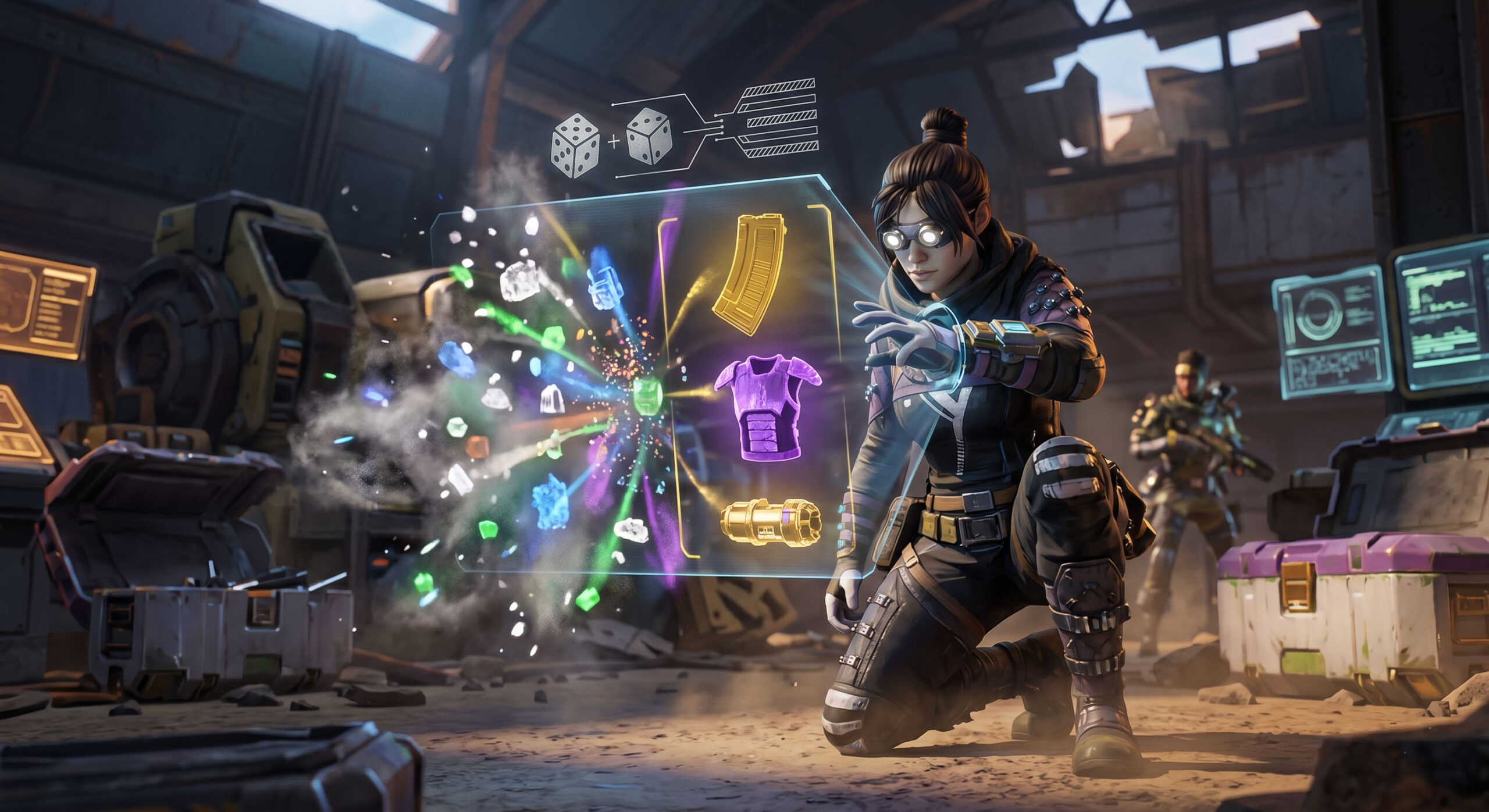





Apex Legends has more pronounced luck mechanics than almost any other competitive shooter on the market. The drop sequence at the start of every match introduces chaos before a single shot is fired. Loot pools are randomized within zones. Ring placement can favor one squad and punish another by no fault of their own. The roster of teammates in solo queue is its own roll of the dice. The genre’s competitive players have spent years working out how to engage with all this randomness in a way that puts them in the top brackets, and what they have figured out is interesting.
The starting point for understanding the Apex luck question is recognizing that the game is built around it deliberately. The randomness is not a flaw the developers want to remove but a feature that produces emergent gameplay, prevents stale optimal strategies and rewards adaptability over rote memorization. The best Apex players are not the ones who get lucky but the ones who have built robust decision-making frameworks that work across the full range of luck outcomes the game can produce.
The drop decision and the first risk of every match
The drop sequence in Apex is where the first major luck decision gets made. Squads pick their landing zone from a moving dropship, and the choice involves a trade-off. Hot zones produce more loot and faster engagements but also more competition for that loot. Safer zones produce fewer immediate threats but slower gear-up. Where everyone else drops is partially visible but not entirely, so the drop choice is made under incomplete information.
Top-tier players treat the drop as a probability calculation rather than a personal preference. They model where the dropship trajectory passes, where opponents historically prefer to land, what loot the chosen zone offers, and what the rotation will look like 90 seconds in. The drop is a hand of cards being dealt, and the goal is to read the deal correctly and commit to a plan that works across the most plausible outcomes. Players who insist on dropping the same spot every game tend to plateau quickly because the meta moves and the spot stops being optimal. Players who adapt their drop based on lobby composition, season meta and ring possibility tend to climb steadily.
Why loot RNG is a feature, not a flaw
Loot variance gets the most complaint from new players and the least concern from professionals. A new player who lands and finds only a P2020 will often blame the game. The pro in the same situation improvises around what is available and looks for engagements that fit the loadout. The mental flexibility to adapt to whatever loot arrives is what separates the players who climb from the ones who plateau in the middle of the rank distribution.
The Apex loot system is doing what slot mechanics do across countless other forms of entertainment: producing a steady stream of small chance outcomes that the player has to read, react to and integrate into a larger plan. Players who have internalized that loop tend to enjoy the variance rather than fight it, and they often gravitate toward other formats that produce the same rhythm of commit, watch and adjust. SpinBlitz free slots, a free-to-play social casino platform built around short self-contained spin sessions, is one example of how that same mental loop translates into pure decompression. The format runs on instant feedback and zero commitment, which is the opposite of the high-stakes drops and ring rotations in Apex but uses the same underlying engagement with chance that competitive players already understand.
The ring and the limits of skill
The ring closing pattern in every Apex match introduces a second major layer of luck that even the best players cannot fully outplay. A squad that gets caught on the wrong side of a ring center, with thin rotation paths and aggressive teams on the optimal approach, will lose to a squad that drew the better ring regardless of who has better aim. This is the kind of macro luck that defines the difference among high-skill, top-three and championship placement. The pros who reach championship level are the ones who minimize ring exposure through pre-positioning and movement, not the ones who somehow get lucky with ring draws more often.
The data on professional Apex play shows this clearly. The squads that consistently place in the top three across long tournament series are the ones who waste the fewest minutes on ring-disadvantaged terrain. They drop in places that give them ring flexibility regardless of how the ring eventually closes, rotate early, and commit to safe zones before the next ring is announced. None of this is about predicting ring placement but about preparing for the full range of ring outcomes so that no single ring draw can eliminate the squad.
Squad coordination as collective luck management
Solo queue introduces a uniquely Apex form of luck: the random teammates you get assigned for each match. A great solo queue player is someone who has figured out how to extract reliable performance from random teammates, which is a much harder skill than playing well with a coordinated stack. The mental work involved is real. Quick communication, role flexibility and the willingness to adapt your playstyle to what your teammates can actually do are all tools the best solo queue players use to push the random teammate variable closer to a predictable outcome.
This is the team-level version of luck management, and it parallels how families and communities in many cultures have always engaged with chance: by treating shared moments of uncertainty as opportunities for connection rather than sources of friction. The Apex community has built a lot of culture around solo queue resilience for precisely this reason. The players who frame every random teammate as a chance to demonstrate good gameplay tend to climb faster than the ones who blame their team for every loss.
Why the players who embrace variance climb the fastest
The Apex players who reach Predator rank and stay there have made peace with the role of luck in the game. They have built their decision-making around the assumption that bad luck will happen: the ring will close badly sometimes, loot will be uneven, solo queue teammates will sometimes throw. The peace is not resignation but preparation. The players who carry this mindset through their gaming routines tend to bring the same calm engagement to other forms of chance-based entertainment they use to decompress, and they tend to enjoy gaming as a long-term hobby for years longer than the players who rage at every bad drop. Apex rewards the players who can hold both ends of the spectrum simultaneously: the deliberate skill that wins fights and the open acceptance that some outcomes are simply not in their hands. That balance is what high-level competitive play actually requires, and it shows up clearly in the players who climb the ladder year after year while their peers burn out and quit.
