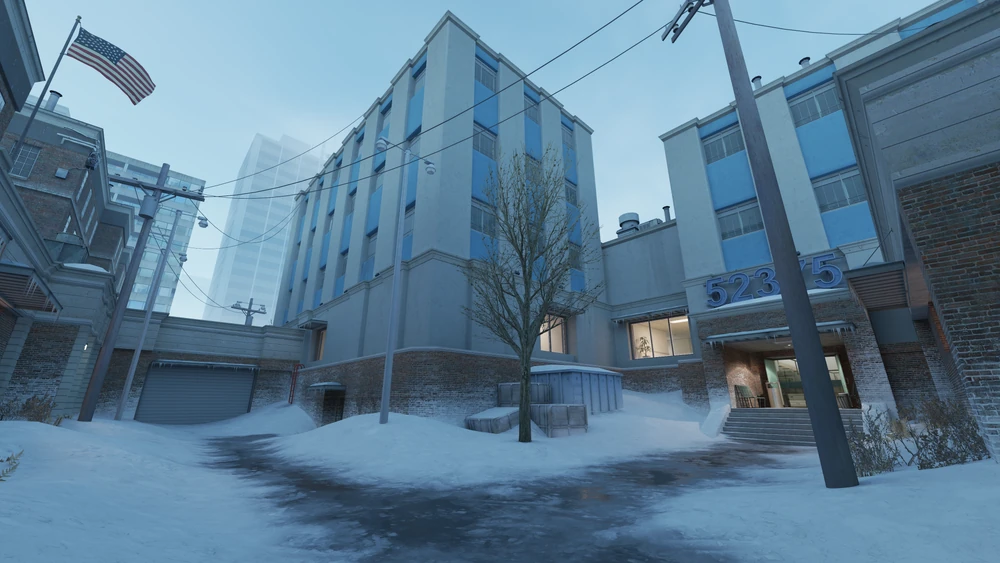

Office stands as the definitive example of why hostage rescue remains a beloved part of the Counter-Strike experience. While the professional circuit revolves almost exclusively around planting bombs, this snowy high-rise provides a unique tactical challenge that has survived since the year 2000.
It is currently the only map of its kind to persist through every major iteration of the franchise, successfully making the leap into the Source 2 engine.
The history and layout of Office
Created by Alexander Manilov, the map known as Office breaks the traditional three-lane structure found in most competitive environments. The layout features a Counter-Terrorist spawn located in an outdoor parking garage, while the Terrorist team starts deep within a corporate complex.
The primary objective centers on the Counter-Terrorists infiltrating the building to extract two hostages located in the back rooms. This indoor-focused design heavily rewards players who master close-quarters weaponry like the XM1014 or the MAC-10.
Unlike most maps, the engagement distances here are extremely polarized. You either face long-range sniper duels in the Parking Garage or frantic, high-speed skirmishes in the Main Hallway. Success on this map requires a deep understanding of how to clear corners without getting caught in a crossfire between the cubicles.
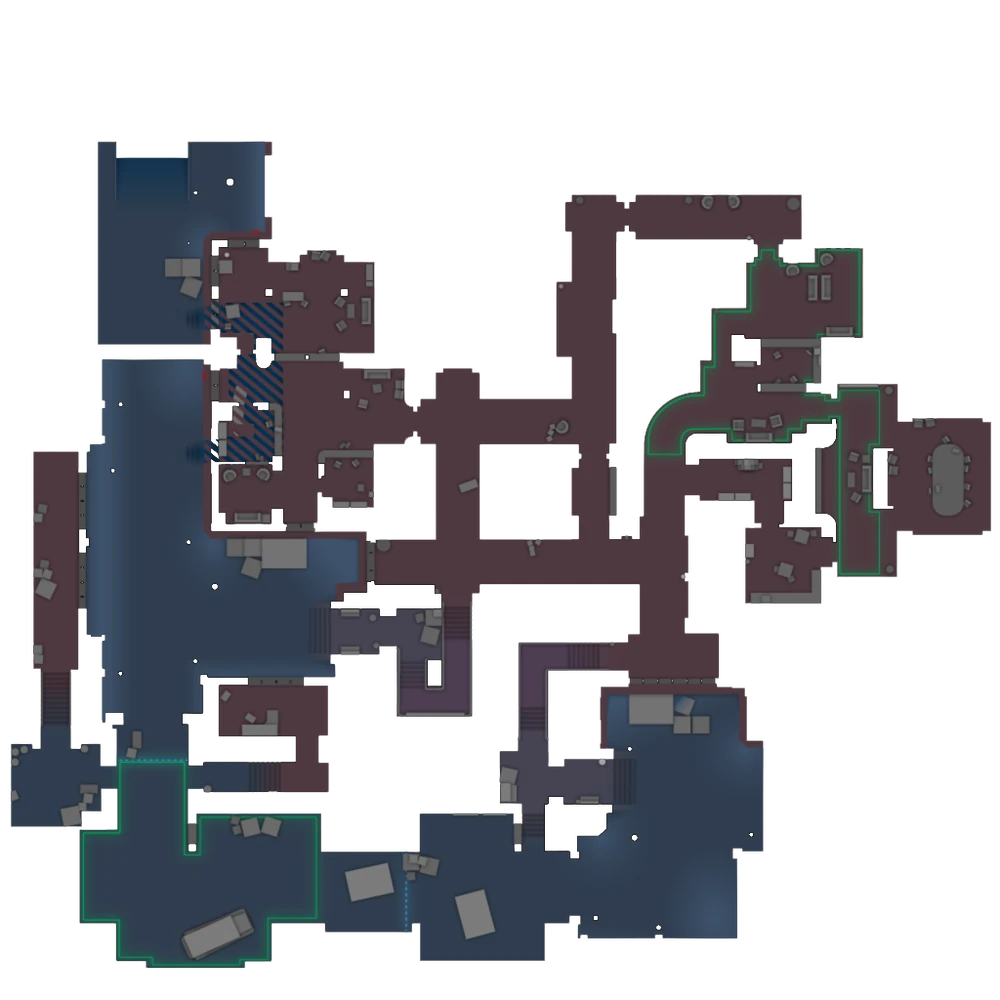
Essential callouts for the Office complex
| Callout Name | Location Description | Strategic Importance |
| Long Hall | The primary corridor leading from the front entrance. | Most common site for heavy utility exchange. |
| Paper | A small room filled with printers and supplies. | Vital for Terrorists holding the back-site hostages. |
| Kitchen | An indoor breakroom near the T-spawn. | A notorious hiding spot for defenders with shotguns. |
| Sniper Tower | The elevated windows overlooking the garage. | Essential for CTs to clear the exterior before entering. |
| Projector | A meeting room connecting the two main halls. | The fastest rotation point for both teams. |
Technical upgrades in the CS2 version of Office
The transition to Counter-Strike 2 significantly altered how players interact with this specific environment. While the map retains its soul, the Source 2 engine introduces mechanical changes that impact every round. Now, these changes had very few effect on the system requirements of your PC, but they had a major one on how you approach the building in-game.
Volumetric smoke and narrow corridors
Enhanced lighting makes the interior conference rooms look pristine, but the real change lies in the utility behavior. Volumetric smoke grenades are particularly oppressive in the narrow corridors of Office because they can effectively seal off entire pathways with a single throw.
Unlike previous versions of the game, smoke now expands to fill the geometry of the Long Hall or Paper, leaving no gaps for attackers to exploit. This forces the attacking team to rely on HE grenades to temporarily “pop” the smoke or risk pushing blindly into a defender.
Interactive glass and environmental destruction
The updated glass-shattering mechanics have changed the flow of the round entirely. Breaking the large windows in the Front Office is now a core tactical element, allowing for quick exits or unexpected entry points for the Counter-Terrorist side.
Because glass shards now behave as physical objects and the sound design is more distinct, breaking a window acts as a loud, permanent signal to the enemy team that a new lane has opened. This added verticality ensures that defenders can never be truly comfortable just watching the doors.
Mastering the dynamic of hostage maps
Unlike defusal scenarios you would see on Nuke or Dust 2, where the CTs defend a site, hostage maps flip the script and the traditional roles of the two factions. In this mode, the pace is dictated by the extraction timer rather than a ticking bomb. Most importantly, the T-side is the one doing the defending now.
The defender’s advantage in corporate environments
In Office, the Terrorists are the ones digging in and waiting for the clock to run down. They hold the “power positions” like Kitchen or Paper, forcing the attackers to push through narrow choke points.
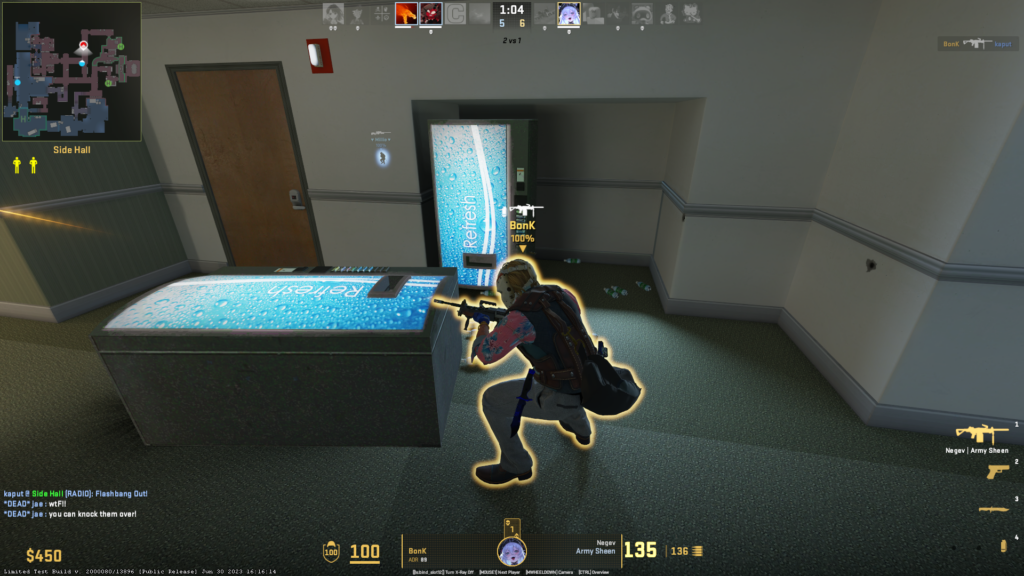
The meta on this map often dictates a heavy reliance on flashbangs because there is almost no room for lateral movement once inside the building. A single Molotov in a doorway can stall an entire CT execution for several seconds, which is a lifetime in such a compact space.
Coordinated extraction strategies
Effective strategies on this map usually involve a split push rather than a blind rush through one door. If the Counter-Terrorists can pressure the Windows while simultaneously pushing through the Side Hall, the defensive line often crumbles under the pressure of two angles.
Once a hostage is picked up, the game shifts into a frantic escape mission. The CTs gain extra time upon picking up a hostage, but their movement is slowed, making the retreat back to the Parking Garage the most dangerous part of the round.
Office remains the undisputed king of its category because it balances nostalgia with genuine tactical depth. It provides a refreshing break from the standard competitive pool while maintaining the high-stakes gunplay that defines the series.
