





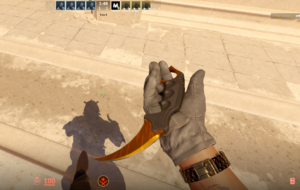

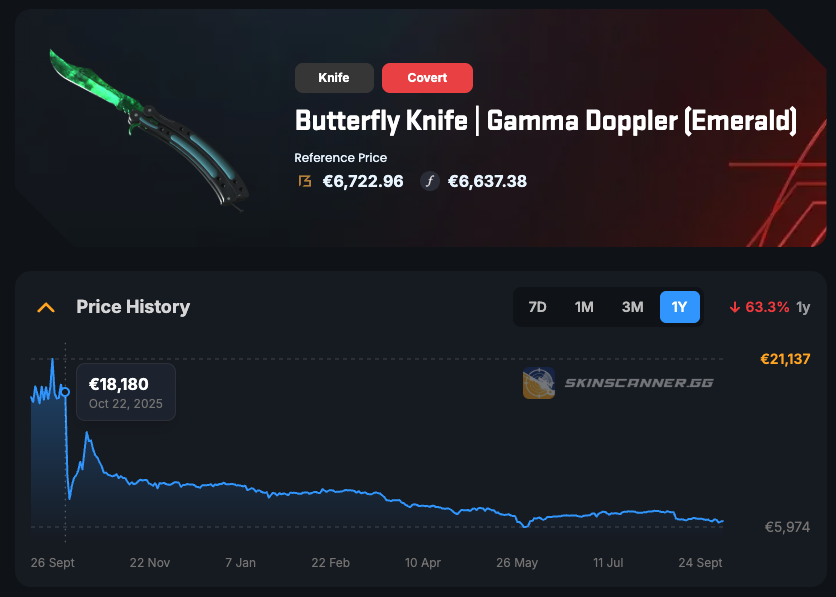
The Counter-Strike 2 economy has experienced a severe contraction over the past year. Data from priceempire.com shows the total market capitalization for skins dropped from a peak of $10.4 billion in October 2025 to $6.5 billion today. Specific premium items reflect this steep decline. A Butterfly Knife Gamma Doppler (Emerald) valued at $21,000 in October now trades near $6,500 as seen on the price comparison site Skinscanner.gg.
While these figures paint a grim picture of recent market performance, underlying supply mechanics suggest the depreciation phase could be approaching its end, presenting a potential window for skin traders*.
The systematic exhaustion of Covert supply
Following a game update that enabled players to use Covert skins in trade-up contracts for Gold items, the community has systematically destroyed millions of top-tier weapon finishes. The exact volume of this destruction is trackable. By isolating Pattern ID 1000, a specific identifier applied exclusively to items generated through trade-ups, analysts can calculate the exact number of Coverts burned in the process.
The data reveals aggressive depletion rates across multiple collections. Approximately 80 percent of all Coverts from the Riptide case have been consumed, accounting for around 1.6 million destroyed skins. The Fever case has lost 74 percent of its Coverts, equating to 700,000 items. The Clutch case sits at a 61 percent depletion rate, representing another 1.6 million destroyed reds. Mid-tier cases like the Glove, Breakout, Chroma, Gamma, and Spectrum cases show depletion rates around 40 percent.
Hidden scarcity within public databases
The reported depletion percentages only reflect skins registered in public databases. These figures fail to account for the vast volume of inventory locked in abandoned or trade-banned accounts. Many skins originating from older collections have sat dormant for up to a decade.
When adjusting for inactive inventories, the actual supply of accessible Covert skins is drastically lower. If half of the registered skins are locked away in inactive accounts, a reported 40 percent trade-up rate means that roughly 80 percent of the active, circulating supply has already been consumed. The community is exhausting the pool of accessible Coverts at a much faster rate than surface-level statistics indicate.

Future supply restrictions and market stabilization
The mass execution of Covert trade-ups is directly responsible for flooding the market with newly generated Gold items over the past year. This massive influx of supply drove prices down across the board. However, this trend is mathematically unsustainable.
As the required input materials become increasingly scarce, the return on investment for trade-up contracts worsens. YouTuber and Counter-Strike market commentator TDM_Heyzeus is among those who believe this mechanical bottleneck will force a market shift. In his recent video analysis, which you can watch below, he outlines how the exhaustion of Covert skins will inevitably choke off the supply of new knives entering the market.
Coupled with Valve phasing out older cases, the reduction in active Covert supply will severely restrict the generation of new premium items. For traders and investors evaluating entry points, this data signals a structural shift. Once the current surplus of knives is absorbed by the player base, the primary mechanism for mass-producing high-tier items will become too expensive to execute. If player demand returns to historical averages, the restricted supply pipeline will likely halt further price depreciation and force valuations upward.
* As seen in the past, Valve is not afraid to shake up the market completely with new features that can change everything. So treat skin investments like gambling. Never spend more money than you can afford to lose.
