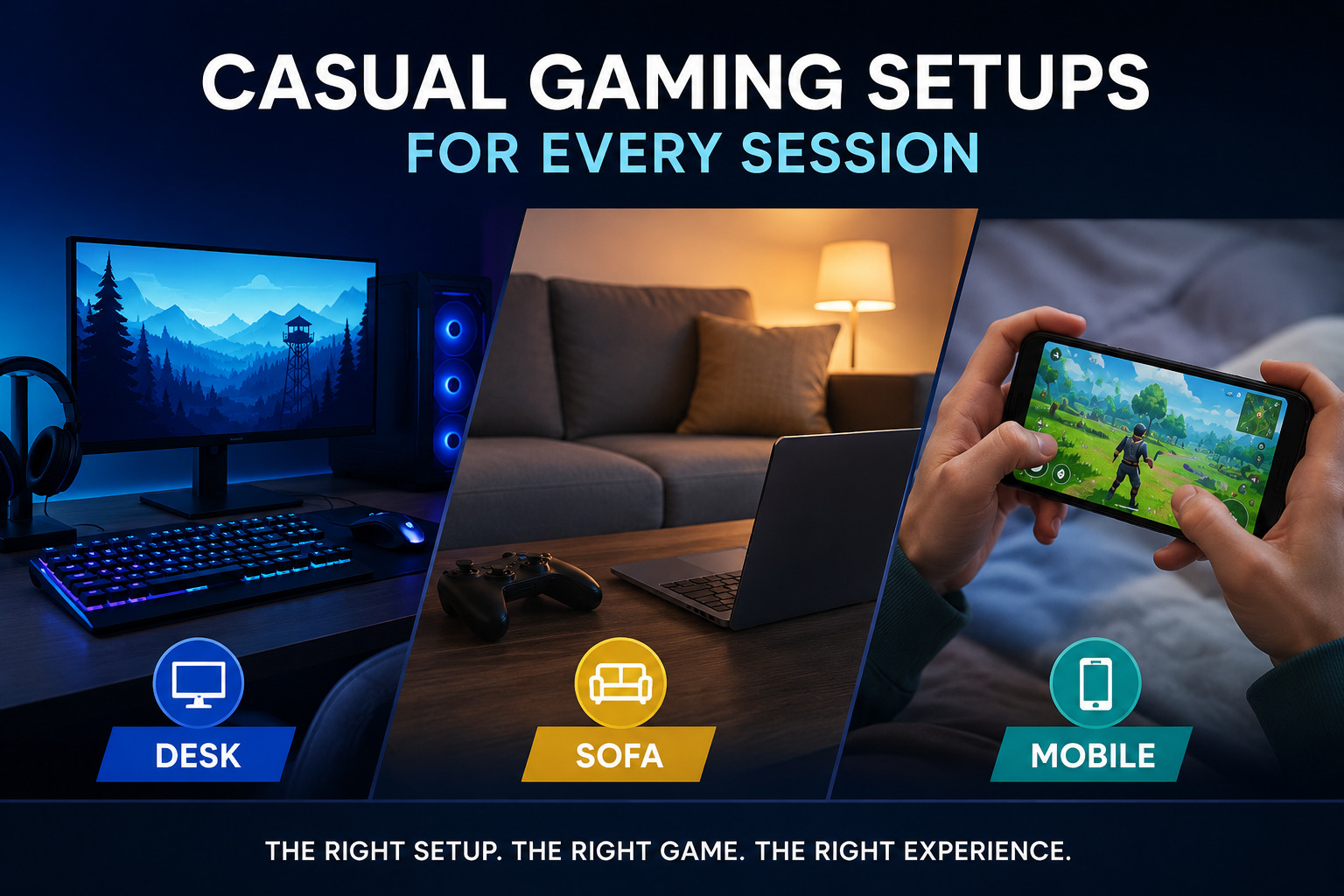





A casual gaming setup does not have to be ridiculously expensive to be effective. It has to be well-designed and carefully organized based on what the games you play require. Ranked shooters ask for repeatable aim, stable audio, clear comms, and a chair position you can hold through pressure. Short sessions ask for access, comfort, and a screen that fits the game well.
Gaming history has always been tied to where the player is. Arcade cabinets made play public and upright. Home consoles moved it to the living room. Handhelds let players carry a session onto a bus, into bed, or across a lunch break. One discussion of digital play in cities notes that mobile devices helped move games away from fixed public locations, such as arcades and cybercafes, and into everyday spaces.
Match the Game to the Screen
The best setup starts with the game’s demands. A Valorant match belongs at a desk because small errors stack fast. Your mouse space, refresh rate, headset, posture, and keyboard angle affect how cleanly you react.
The same desk can feel excessive for a turn-based RPG, a mobile puzzle game, a daily store check, or a short browser session where the player wants comfort more than a mechanical edge. Lighter online formats make that difference obvious. When we swap to games that are designed to be casual and easygoing, such as slots, we really notice if the space is overbuilt and unnecessary; it detracts from our comfort and enjoyment in these moments.
Slots games are focused on flexible play and accessibility; they are developed with the idea that a user might play them anywhere. The format is built around short rounds, clear visuals, quick recognition, and flexible device use, rather than a long match structure. You don’t need to be sitting at a desk with crystal-clear audio and a perfectly angled screen – and while you can play in that kind of setup, it often detracts from the freedom that slots offer. These games instead invite you to enjoy them from anywhere, maximizing the fun.
When you play slots games online using a mobile device or a laptop, you have far more options. Take them to a friend’s house for an evening of fun, or enjoy them on your lunch break. Spin a few reels while you’re cooking dinner. The point of these games is flexibility. The same goes for many mobile puzzles, casual platformers, and more. It’s always worth thinking about what screen makes sense, how much attention the session needs, and where the player can enjoy it without turning a small break into a full desk appointment.
That question becomes more concrete when the setup is treated as a combination of place, device, and mood. A quick pick on Instagram uses sofa, bed, reclining chair, phone, laptop, PC, and drink choices to frame the same idea in a lighter way. The useful point is simple: casual play is often built around the room first, then the device.
The Desk Still Has a Job
None of this weakens the classic gaming desk. For competitive games, it is still the cleanest base. A proper desk gives your arms room, keeps the monitor at a steady distance, and removes awkward compromises from your input setup. That matters whenever speed and precision are the priorities.
The mistake is making the desk the default answer for every type of play. A controller-heavy action game can feel better on a couch because the input method does not need a mousepad. A slow RPG can work on a laptop because reading, menu decisions, and turn timing do not require an upright posture. A phone can handle short, self-contained games because the device is already where the quick session happens.
Many setup guides treat the room like a performance lab, but most players use more than one mode. The same person might grind ranked on a PC, clear dailies on a mobile, play a narrative game on the sofa, then check a browser game later. A good setup is a set of habits that fit the game being played.
A Better Casual Setup Has 4 Parts

The first thing to think about is friction. If a game is meant for short sessions, it should not require you to go into a different room, boot up a high-powered machine, and wait for everything to load. Keep quick games on the device where you naturally open them. Save the full boot-up ritual for games that deserve the longer block.
Second, consider input. Mouse and keyboard suit precision. Controller suits movement, camera comfort, and relaxed distance from the screen. Touch suits fast decisions and simple, readable layouts. When the input feels wrong, the whole setup feels wrong.
The third part is posture. Comfort is not the same as collapsing into the softest place available. If the session lasts longer than expected, your neck, wrists, and lower back will notice. A reclining chair can work for controller play. It will not fix a laptop balanced at a bad angle for an hour.
The fourth part is exit shape. Some games end cleanly. Others keep adding one more task, queue, map, round, or timer. Short-session setups work best when the game has a natural stopping point, and the device does not trap you in an awkward position.
Short Sessions Need Cleaner Choices
A casual gaming setup should make the session easier to start and easier to leave. Put the competitive games where your attention is strongest. Let the sofa handle slower games. Let the phone handle quick checks and games designed around small pockets of time. Use the laptop when you want flexibility without shrinking everything onto a small screen.
The modern player does not need to prove their seriousness by sitting at a desk for every game. The better standard is fit. Screen, input, room, and session length should agree with each other. That is especially true for mobile play, where even standing versus walking can change visual fatigue, as shown in this Scientific Reports study.
