
The Counter-Strike 2 tournament calendar leaves little room to breathe for the top teams. With consecutive events running throughout the year, professional players are spending less time at home and more time on the road.
The 2023 revision of the tournament scene in Counter-Strike opened up the market for new (and old) tournament organizers, who had previously seen ESL and BLAST running the show. Valve’s intention to let other companies enter the tournament circuit has led to an increase in the number of new S-tier tournaments since it was implemented in 2025.
S-Tier tournaments in CS2
| Year | Total Scheduled Events | Held/Completed Events | Cancelled/Postponed | Total Prize Pool (Held) | Average Prize Pool (Held) |
| 2022 | 12 | 12 | 0 | $8,435,500 | $702,958 |
| 2023 | 17 | 17 | 0 | $10,155,000 | $597,352 |
| 2024 | 18 | 18 | 0 | $11,435,000 | $635,277 |
| 2025 | 23 | 20 | 3 | $17,192,500 | $859,625 |
| 2026 | 30 | 22 | 8 | $23,587,500 | $1,072,159 |
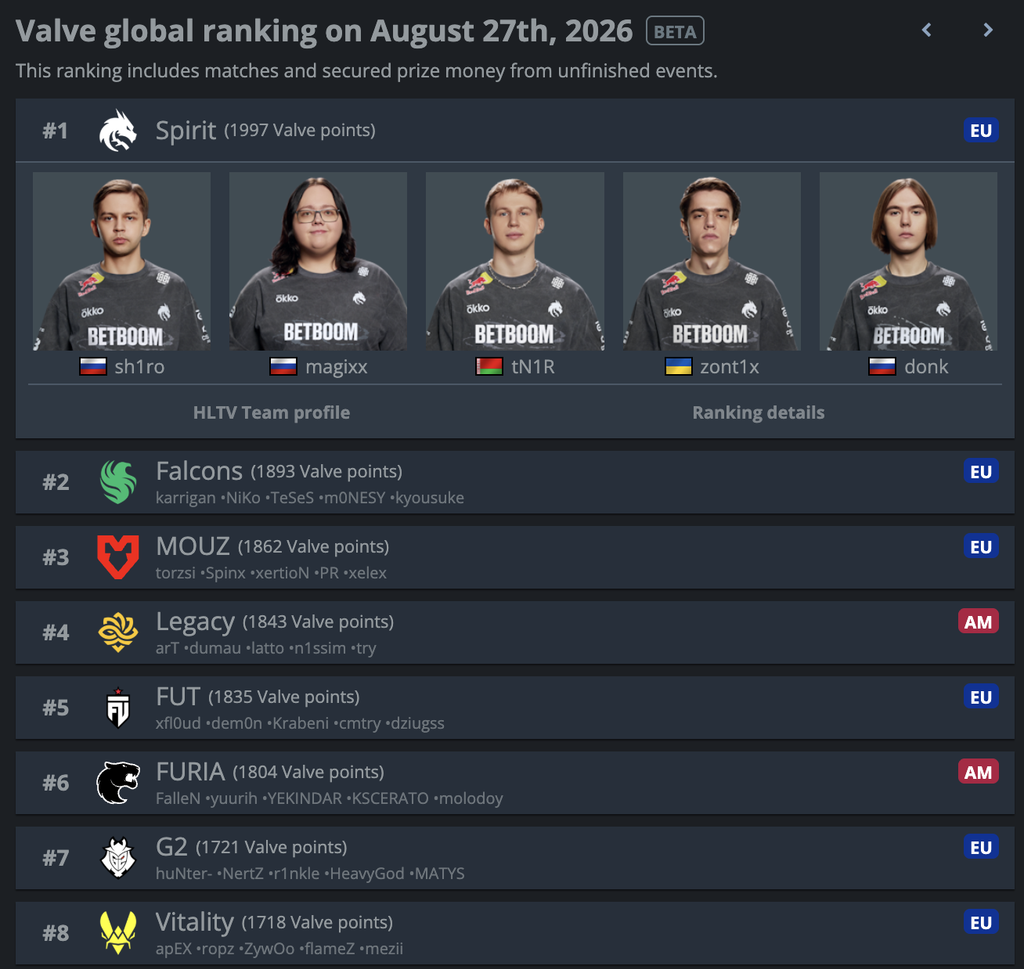
From the outside, this could look like a very positive development for the Counter-Strike scene, which is hard to argue against. But when you combine this with the VRS race, which is heavily dictated by prize money, it does put extra pressure on the organizations to perform. The volatility of the VRS rankings could be seen in the case of Team Vitality. Despite winning five S-Tier events in 2026, they found themselves down to 8th place on the VRS ranking at the end of August after failing to make it to the top 4 in their last four tournaments.
In recent interviews with pley.gg, several professionals shared their perspectives on the current schedule, highlighting the physical toll, the logistical hurdles, and the potential decline in competitive quality.
For Mareks “YEKINDAR” Gaļinskis, the current system is reaching a breaking point with regard to tournament integrity and player stamina.
In terms of schedule, I’ve been saying it in multiple interviews. I feel like it’s getting super unhealthy in terms of competition for a long time now,” YEKINDAR explains.
The continuous cycle of events can cause the prestige of individual tournaments to blur. YEKINDAR points out that playing an event every second week reduces the perceived value of each competition. He suggests that a reduction in the number of events would actually benefit the overall level of play.
I don’t think we’re getting 100% out of many players and many teams right now,” YEKINDAR says. “Most of the best CS can come from playing a tournament and then having a one-week break for changing approaches in-game. I don’t consider a break being just relaxing, but also just having a moment to practice and change.
Natus Vincere’s in-game leader, Aleksi “Aleksib” Virolainen, shares a similar view regarding team performance. He notes that the lack of practice time between events directly impacts the servers.
Maybe the quality for certain teams might fall down because of the amount they’re playing, or maybe individuals might feel fatigued and then the form might go down because of that,” Aleksib states. He adds that prioritizing practice and bootcamps between travels often gets overwhelming.
Logistical challenges and life on the road
Beyond the server, the travel schedule creates personal and logistical hurdles. Nikita “HeavyGod” Martynenko acknowledges the difficulty of balancing a professional career with a private life.
We’re going sometimes from event to event, and it can be one month out of home,” HeavyGod explains. “It’s not easy obviously to travel and be far away from family, close friends, wife, or girlfriend.
For players outside the European Union, the consecutive tournament structure presents strict legal challenges. Maksim “kyousuke” Lukin detailed the complications he faces as a Russian citizen navigating the visa systems.
We have one entry visa. When you have two tournaments connected, you are going straight from the first one to the second,” kyousuke says, recalling a specific instance where he had to stay in Krakow for almost a week after an event just to travel directly to Cluj-Napoca without leaving the Schengen zone. “I think it’s the hardest part for me.
Accepting the continuous grind
Despite the clear physical and mental demands, the players accept the reality of their profession. Justinas “jL” Lekavičius plainly stated that “players need to be taken care of for sure,” but the general consensus remains that the schedule is an inherent part of being a top-tier professional.
HeavyGod ultimately views the packed calendar as a positive element for his career development and personal opportunities.
For me, the schedule is fine,” HeavyGod says. “I think players are getting a lot of opportunities to lift trophies, grind, visit the whole world, and I’m thankful for that.
Aleksib echoes this sentiment, framing the relentless travel as a product of the players’ own ambitions. The sting of defeat amplifies the exhaustion, while victory temporarily cures it.
Whenever you lift a trophy, you feel like you don’t need any time off ever. And when you’re getting beaten in groups after you practiced for two weeks straight, it feels horrible,” Aleksib concludes. “There’s always two sides of the coin to everything, but at the end of the day, I do think that we all need to appreciate what we’re doing here. It’s all a grind, one big grind.
You can see all upcoming tournaments on our tournament page.
